



Today, it feels like everyone is a “fascist.” Scroll through social media or tune into a heated parliamentary debate, and you will hear the word thrown at everything from tax hikes and public health mandates to loud political rivals. The problem is simple: when a word is used to describe everything, it ends up meaning nothing.
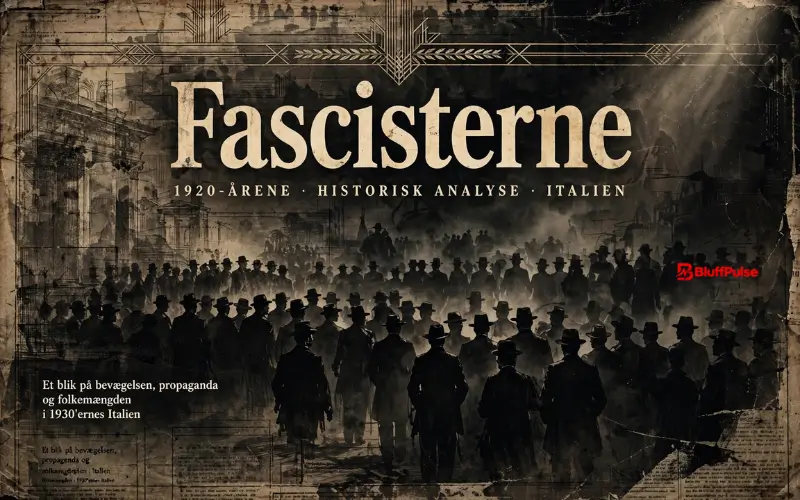
If you look up the Scandinavian term fascisterne (the Danish and Norwegian word for “the fascists”), you aren’t just looking at a political insult. You are looking at a specific, brutal historical movement that tore 20th-century Europe apart. Understanding who fascisterne actually were means stripping away modern exaggerations and looking at how this movement grew out of the wreckage of World War I, how dictators legally dismantled democracies from the inside, and why the movement largely hit a brick wall in the Nordic countries.
Even the word itself tells you how the ideology works. Fascismo comes from the Italian fascio (a bundle) and the ancient Roman fasces—a bundle of wooden rods tied tightly around an axe. Roman magistrates had these carried in front of them as a clear visual warning: a single stick snaps easily, a bundle cannot be broken, and the axe blade holds the state’s ultimate power over life and death.
To make sense of fascisterne—and to spot real anti-democratic threats today—we need to look at what they actually believed, how they seized power in Italy and Germany, what happened to their followers in Scandinavia, and how historians separate genuine fascism from standard strongman rule.
Core Characteristics: What Actually Defines “Fascisterne”?
Unlike communism or classical liberalism, fascism didn’t start with a thick book of philosophy. Karl Marx wrote Das Kapital; Adam Smith wrote The Wealth of Nations. Fascists had no equivalent. They were street fighters, aggrieved war veterans, and nationalists who built their ideology on the fly. Because it looked slightly different in every country, historians spent decades arguing over how to define it.
The Myth of National Rebirth
In 1991, British historian Roger Griffin came up with a definition that most scholars now agree on. He called fascism “palingenetic ultranationalism.”
That sounds like heavy academic jargon, but the idea is straightforward. Palingenesis simply means rebirth—like a phoenix rising from the ashes. Every fascist movement runs on the same core story: Our nation used to be great, it has been humiliated and rotted out by internal enemies (liberals, socialists, minorities), and the only way to save it is a violent, sweeping awakening.
Total Control and the Cult of the Leader
In a fascist state, there is no such thing as “none of the government’s business.” As Benito Mussolini famously put it in 1932: “Everything in the State, nothing outside the State, nothing against the State.”
Independent trade unions, rival political parties, free newspapers, and even local sports clubs or youth groups are either taken over by the party or shut down. At the top of this pyramid sits the supreme leader—Il Duce in Italy, Der Führer in Germany, or Føreren among Scandinavian fascists. In this system, the dictator isn’t just a president or prime minister; he is treated as the living voice of the nation, above the law and beyond questioning.
The “Third Way” Economy
During the 1920s and 1930s, fascisterne sold themselves as a bold “Third Way”—an alternative to both cutthroat free-market capitalism and Soviet communism.
- Why businesses backed them: Fascists hated Marxism and physically beat up striking workers and union leaders. That terrified the left and won fascists massive financial support from wealthy factory owners, landowners, and conservative elites.
- Why they weren’t free-market capitalists: Fascists also despised the messy, individualistic nature of liberal capitalism, especially after the 1929 stock market crash.
- How it worked in practice: They set up a system called corporatism (or state-directed capitalism). Private companies kept their factories and their profits, so long as they produced what the regime demanded—usually weapons, infrastructure, and military gear. Independent unions were banned and replaced by state-run fronts that barred workers from striking.
Trench Politics and Street Violence
Fascism views peace as soft and decadent. It takes the ruthless mentality of the World War I trenches and drops it straight into civilian life. Uniformed gangs—like Mussolini’s Blackshirts or Hitler’s Brownshirts—weren’t a side show. They were the movement. To a fascist, street violence wasn’t an ugly means to an end; it was seen as a healthy, purifying force that toughened up the youth and swept away the weak.
The Interwar Rise: Italy and Germany
Fascism was born out of the trauma of World War I. Millions of shell-shocked soldiers came home to broken economies, redrawn borders, and bickering parliaments that couldn’t fix the mess. Add in the panic among the middle and upper classes after the 1917 Bolshevik Revolution in Russia, and Europe was primed for strongmen promising order.
Mussolini’s Italy (1922–1943): The Blueprint
Even though Italy was on the winning side of WWI, nationalists felt cheated out of territory they had been promised—calling it a “mutilated victory.” By 1919 and 1920, two years of massive strikes, factory takeovers, and land seizures (known as the Biennio Rosso, or Two Red Years) had brought Italy to a standstill.
Enter Benito Mussolini. A former socialist newspaper editor who had pivoted hard toward aggressive nationalism during the war, Mussolini organized jobless veterans into armed squads called the Fasci Italiani di Combattimento. Bankrolled by nervous landowners and business bosses, his Blackshirts roamed the countryside beating up socialists, burning down union offices, and forcing elected local officials to resign at gunpoint.
In October 1922, Mussolini gambled everything on the March on Rome, sending tens of thousands of Blackshirts toward the capital. The Italian army could have easily dispersed them, but King Victor Emmanuel III lost his nerve. Instead of declaring martial law, the King invited Mussolini to become Prime Minister. Over the next four years, Mussolini used his legal foothold to choke out Italian democracy, rigging election laws, banning opposition parties after his thugs murdered socialist leader Giacomo Matteotti, and turning Italy into the world’s first fascist dictatorship.
Hitler’s Germany (1933–1945): Racial Totalitarianism
North of the Alps, Germany’s Weimar Republic was reeling from the humiliation of the Versailles Treaty, the trauma of 1923 hyperinflation (when it took a wheelbarrow of cash to buy a loaf of bread), and finally the Great Depression. Adolf Hitler and his Nazi Party (NSDAP) watched Mussolini closely, learning that the easiest way to kill a democracy was to get invited inside first.
While Italian fascism and German Nazism used the same playbook—one-party rule, secret police, youth indoctrination, and aggressive war—there was one massive ideological difference:
- In Italy, the State came first: For Mussolini, the State created the nation. While Italian fascism was brutally violent and colonialist in places like Libya and Ethiopia, biological racism and state-mandated antisemitism weren’t central to Mussolini’s domestic laws until 1938, when he fell securely into Hitler’s orbit.
- In Germany, Race came first: For Hitler, the State was just a tool to protect and expand the biological “Aryan race.” Nazism built its entire worldview around eugenics, racial purity, and a fanatical hatred of Jews, which led directly to the death camps of the Holocaust.
“Fascisterne” in Scandinavia: Why the Movement Flopped
When we look specifically at Scandinavia—where the word fascisterne comes from—a really interesting question pops up: Why did fascism fail so badly in Denmark, Norway, and Sweden during the 1930s?
While Germany and Italy fell to dictators, the Nordic democracies held firm. The biggest reason was practical politics. When the Great Depression slammed both factory workers and farmers, Scandinavian politicians didn’t let their parliaments paralyze. Instead, social democrats and farmers’ parties sat down and hammered out historic compromises—most famously Denmark’s Kanslergadeforlig (Kanslergade Agreement) on January 30, 1933.
Ironically, that deal was signed on the exact same day Hitler became Chancellor of Germany. By passing real economic relief and laying the groundwork for the Nordic welfare model, Scandinavian leaders pulled the rug out from under local fascists. People with jobs, food, and a government that listens rarely vote for extremists in brown shirts.
Denmark: Frits Clausen and the DNSAP
Denmark’s main fascist party was the Danmarks Nationalsocialistiske Arbejderparti (DNSAP), led from 1933 by a rural doctor named Frits Clausen.
Clausen’s party copied the German Nazis down to the swastikas, the brown uniforms, and the stiff-armed salute. Danish voters mostly laughed at them. Even in March 1943—with the German army physically occupying Denmark—the DNSAP only scraped together 2.1% of the national vote (winning a measly three seats in parliament). In fact, Berlin found Clausen so inept that Nazi officials preferred dealing with Denmark’s existing democratic politicians to keep Danish bacon and butter flowing to Germany rather than putting local Danish fascists in charge.
Norway: Vidkun Quisling and Nasjonal Samling
Norway’s brush with fascisterne was much darker. In 1933, a former defense minister named Vidkun Quisling started Nasjonal Samling (National Gathering). Blending Italian fascism, German Nazism, and romanticized Viking mythology, Quisling’s party was a total flop at the ballot box. They never won a single seat in the Norwegian parliament and peaked at less than 2% of the vote before the war.
Then came April 9, 1940. As German troops invaded Norway and the Norwegian King and elected government fled north to fight back, Quisling walked into an Oslo radio station and declared himself Prime Minister in a broadcast coup.
The Norwegian public refused to accept him, and even the Germans sidelined him at first before putting him back as the figurehead “Minister President” of a collaborationist regime from 1942 to 1945. His betrayal stunned the world so deeply that British newspapers and Winston Churchill turned his name into a permanent English word: a quisling—anyone who sells out their own country to an invader.
The Post-War Settling of Scores
When World War II ended in May 1945, neither Denmark nor Norway swept collaboration under the rug. Both countries launched massive legal purges:
- In Norway (Landssvikoppgjøret): Police investigated over 90,000 cases of treason and collaboration. Quisling and 24 others were executed by firing squad, while thousands of Nasjonal Samling members went to prison, paid heavy fines, and lost their voting rights.
- In Denmark (Retsopgøret): Authorities arrested around 40,000 people and convicted roughly 13,500—mostly men who had volunteered for German Waffen-SS units (like Frikorps Danmark) or worked as Gestapo informers. Denmark brought back the death penalty retroactively for wartime treason and executed 46 collaborators.
Fascism vs. Authoritarianism vs. Right-Wing Populism
Because the word “fascist” gets overused today, it helps to separate three things that often get lumped together: Classical Fascism, Authoritarianism, and Right-Wing Populism. Here is how historians and political scientists tell them apart:
| Dimension | Classical Fascism | Authoritarianism | Right-Wing Populism |
| Core Goal | Total revolution and national rebirth | Preserving the status quo | Challenging elites for “the people” |
| Public Role | Constant mass mobilization | Passive obedience | Electoral mobilization |
| Democracy | Abolishes it completely | Restricts or rigs it | Operates within it |
| Violence | Glorified; uses street militias | State police/military force | Rejected for ballot-box wins |
The easiest way to spot the difference is to look at what the ruler wants regular people to do. Traditional authoritarian dictators—like military juntas or Spain’s Francisco Franco in his later decades—want people to stay home, mind their own business, and stay out of politics while the army, the church, and wealthy elites run the country.
Fascists are the exact opposite. They want the public constantly whipped into a frenzy—marching in torchlight parades, joining party youth leagues, and preparing for war.
Neo-Fascism: What Does It Look Like Today?
After 1945, the images of bombed-out European cities and liberated concentration camps made open fascism toxic. Nobody could put on jackboots, wave a swastika, and expect to win a modern European election.
To survive, post-war neo-fascists changed their wardrobe. From the late 20th century onward, movements tied to the European “New Right” (Nouvelle Droite) and modern “identitarian” groups ditched military uniforms and talk of biological master races. Instead, they put on suits and started talking about “cultural preservation” and “ethnopluralism.” Rather than marching on capitals with rifles, modern far-right extremists often use the free-speech protections of liberal democracies to slowly chip away at minority rights and independent courts from the inside.
In 1995, the Italian writer Umberto Eco—who grew up under Mussolini—wrote a famous essay called Ur-Fascism (Eternal Fascism). He argued that while a new fascist movement won’t look exactly like the 1930s version, it usually shows a cluster of familiar warning signs:
- Obsession with a plot: Followers are told the nation is under attack by a shadowy global conspiracy. At the same time, the leader claims the enemy is both terrifyingly powerful and pathetic enough to be crushed easily.
- Fear of difference: Natural anxieties about outsiders, immigrants, or minorities are stoked to unite a frustrated middle class.
- Hatred of nuance and questioning: Critical thinking, science, and open debate are treated as weak or unpatriotic.
- Fake populism: The leader claims that he alone speaks for the “real people,” meaning any parliament, judge, or election result that goes against him is automatically corrupt and illegitimate.
Why Getting the History Right Matters?
If the history of fascisterne teaches us anything, it is that fascism never takes over a healthy, working society. In both 1920s Italy and 1930s Germany, it took a complete breakdown—shattered economies, deep national humiliation, deadlocked parliaments, and short-sighted conservative leaders who arrogantly thought they could hand power to fascist extremists and keep them on a leash. Where democratic politicians actually solved working-class problems—like in 1930s Scandinavia—the fascists were left shouting on the sidelines.
Keeping the word “fascist” historically accurate isn’t about policing language for the sake of it. It’s about remembering the boy who cried wolf. If we call every politician we dislike a fascist, we numb ourselves to the word. Remembering who fascisterne really were—and how they traded human freedom for the lie of national greatness—is the best way to make sure we recognize the real thing if it ever knocks on the door again.
Frequently Asked Questions (FAQ)
1. What does the word “fascisterne” mean?
Fascisterne is the Danish and Norwegian word for “the fascists.” It is used to describe both the historical followers of Mussolini and Hitler in interwar Europe and the local Scandinavian fascist parties that collaborated with Nazi Germany during World War II.
2. Where did the word fascism come from?
It comes from the Italian word fascio (a bundle) and the Latin fasces. In ancient Rome, the fasces was a bundle of wooden rods tied around an axe, carried in front of officials to show that unity creates unbreakable strength and that the state holds the ultimate power to punish.
3. Was fascism a left-wing or right-wing movement?
Historians firmly place fascism on the far-right. Even though the German Nazi Party put the word “Socialist” in its name to win over working-class voters, both Hitler and Mussolini banned independent trade unions, locked socialists and communists in concentration camps, protected private corporate property, and believed in strict national and racial hierarchies rather than human equality.
4. How was Italian Fascism different from German Nazism?
The biggest difference was biological racism. Mussolini’s movement focused on the total power of the State and rebuilding a new Roman Empire; he didn’t pass official antisemitic racial laws in Italy until 1938 under pressure from Hitler. German Nazism was built entirely around biological race, eugenics, and the belief that the “Aryan race” needed to conquer territory and wipe out European Jews.
5. Who were the main fascist groups in Denmark and Norway?
In Denmark, the main group was the DNSAP (Danmarks Nationalsocialistiske Arbejderparti), led by Frits Clausen. In Norway, it was Nasjonal Samling (National Gathering), led by Vidkun Quisling, who ran a pro-Nazi collaborationist government during the German occupation.
6. Why did fascism fail to catch on in Scandinavia during the 1930s?
The Nordic countries had strong democratic traditions, respected monarchies, and practical labor unions. More importantly, during the Great Depression, Scandinavian social democrats and farmers’ parties worked together to pass major economic relief deals (like Denmark’s 1933 Kanslergadeforlig), which kept people out of the extreme poverty that drove voters toward extremists in Germany.
7. Did Mussolini and Hitler take power by force or through elections?
Both used a mix of street violence and legal backroom deals. Neither won an outright majority in a free and fair national election, and neither overthrew the government by military force. Instead, they used paramilitary thugs to cause chaos in the streets until traditional conservative leaders (King Victor Emmanuel III in Italy; President Hindenburg in Germany) legally appointed them to lead the government, falsely thinking they could control them.
8. What is the difference between a fascist and an ordinary dictator?
A standard authoritarian dictator wants people to stay quiet and stay out of politics so the regime can keep things the way they are. A fascist dictator wants a total revolution—demanding that citizens constantly march in rallies, join party organizations, and dedicate their entire private lives to the state and war.
9. How did the economy work under fascism?
Fascist regimes ran on state-directed capitalism (corporatism). Factory owners and big businesses kept their private property and profits, but the government told them what to produce—mostly weapons and military supplies—while banning strikes, crushing independent unions, and freezing workers’ wages.
10. What happened to Scandinavian fascists after WWII ended?
After liberation in May 1945, both Denmark (Retsopgøret) and Norway (Landssvikoppgjøret) put thousands of collaborators on trial. Tens of thousands of local fascists and informers were fined or sent to prison, and top traitors—including Norway’s Vidkun Quisling and 46 Danish collaborators—were executed.